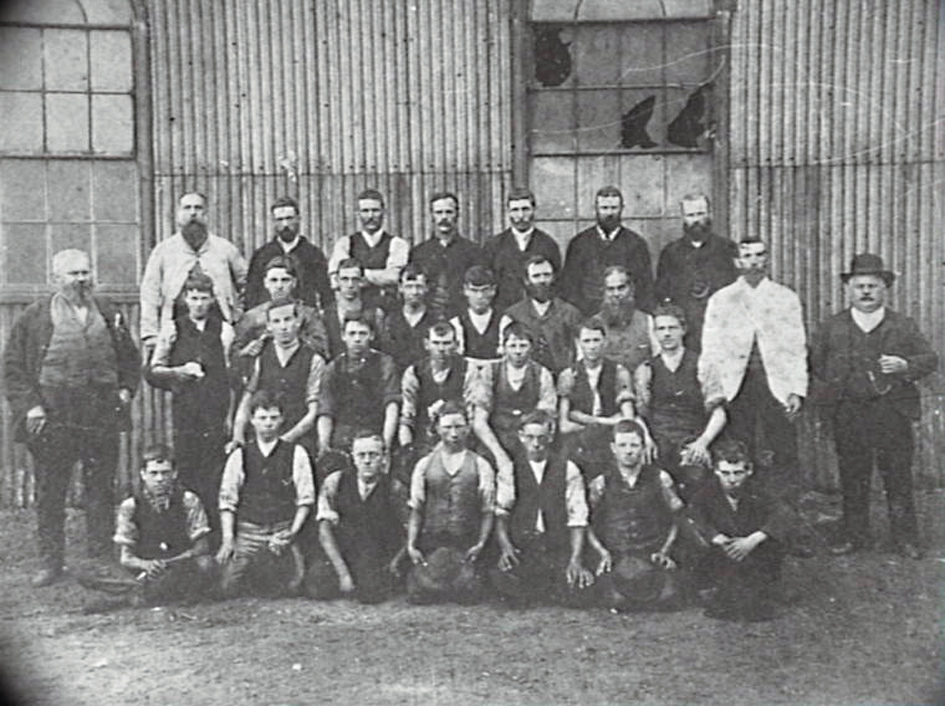
Photo shows 1905 workers at the Railway Goods shed courtesy of Penrith Library
By Lyn Forde – President/Research Officer of St Marys & District Historical Society Inc.
IN January 1900 a magisterial enquiry was held at Penrith Court House before Arthur Judges J.P., on the death of William John Vine, an engine driver on the railway who was found lying dead in the bush about 100 yards from his residence at Hornseywood at Penrith having been shot through the head. At the enquiry Austin Joseph Upton said that he was a wood carter and resided in Penrith and was at Hornseywood riding near the residence of William when he saw the body of a man lying face down on the ground and noticed blood on his left arm and saw a gun close in front of him on the ground with his right arm extended. He said that he didn’t examine the body that was lying in full view of William’s residence. Austin then rode over to the police station and informed Senior-Sergeant Thorndike and accompanied him back to the spot where he pointed out the body that was William who he knew well. He said that when he first saw the body it was about a quarter past 12 (midday). Next to give evidence was Senior-Sergeant Thorndike who said he was informed by Austin that a man was lying near Mr Vine’s residence on the ground, so with Constable Connors, Austin and others they proceeded to the spot about 100 yards from William Vine’s residence and he saw the body lying face downwards with a hole above the left temple and a large quantity of blood that had come away from the wound. The hat belonging to William was four feet from the body in direct line with William’s feet. His body was fully dressed with the exception of a coat and slippers instead of boots. He was dressed in his working clothes but he did not touch the body until Dr Barber came shortly afterwards and then he saw a wound on the right side of the head apparently from a bullet. He examined the gun and found it to be empty, having been discharged recently about 12 hours ago, and on searching the body he found no money but a box of gun caps, knife and tobacco. On examining William’s residence, he found his railway time book fully made up to the 23rd of January and his engine man’s daily report made up and signed. There were five sheets of notepaper beside it, a led pencil, 8 pipes, keys, and some other articles evidently having been laid out in order and the flask of powder was standing in the midst of them. He could find no shot or bullets in the house and the hat produced had the left rim shattered, evidently by the missile on its exit from the head. He had the body of William removed to his residence. He said that he had known William for about 10 years and always knew him as a sober man and had never seen the sign of liquor on him. All the beds in the house were made up and did not appear to have been occupied on that night. Next, William Henry Vine said he was a fireman on the railway and resided in Penrith and was a son of William and from something he heard he went to a place near his late father’s residence where he saw his father lying dead in exactly the position described by the last two witnesses. He said he last saw his father alive on Monday morning and of late his father had often complained of financial and family troubles owing to his wife’s long continued illness and also a death in the family which seemed to affect him very much, but he never heard him threaten to do away with himself. He was frequently saying he had more trouble than he could bear. There was no one in the house at the time of his father’s death as his mother came to his house on that day. His father was born in Wilmington, Sussex in England and came to Australia aged 2 years with his parents on the immigrant ship “Fairlie” in August, 1848. He was the owner of property in Penrith but it was not all free of debt. His father’s life was insured with the A.M.P. Society for £100 and he left a Will and a family of nine who were depending on him. He recognised the gun having seen it in the bathroom of his father’s residence and that his father used marbles for shooting flying foxes and he was a sober man. William’s daughter Letitia Jane Horstman said she last saw her father alive at her shop last Tuesday night and his behaviour seemed very strange. He asked her for foolscap or any kind of paper which she gave him, he then took out his purse and asked for newspaper to roll the paper in, when she came back with the newspaper he clasped her husband’s hand without speaking and threw down (6 shillings-6 pence) in silver on the table and said it will pay for the paper, but she did not want payment, then he clasped her hand, said nothing and left the shop. Charles Randall spoke next saying he was the acting shed foreman on night duty at the railway shed at Penrith, he lived in Penrith and he knew William for about 30 years. William was at work and came in that day from Orange and came into the office that night at 8 p.m. which was a very unusual thing for him to do and he expressed his surprise at seeing him. William said he came in for a chat and to get an order for his money that he handed to him. He put his hand on my shoulder and said that he wanted me to come to his funeral and Charles said he would if William would come to his. He then told me he had made out a very simple Will as far as his family was concerned. Charles advised him to place the Will in the bank but then he was called away, so they shook hands but he was not sure whether William said good-bye or good night. Dr Alexander Barber next said that at about 1.30 p.m., Austin Upton called and asked him to attend by order of Sen-Sergeant Thorndike at Hornseywood about 50 yards from the residence of William where he found him lying in a prone position. He found a gunshot wound penetrating from the right to left side of the head, the left wound was a little higher than the right and at the exit opening, and he found the gun lying on William’s right side pointing towards the body with the right hand extending towards the gun. He said William had fired the gun and inflicted the wound himself and judging from the size of the gun and the position of the body the wound was self-inflicted. Arthur Judges was of the opinion from the evidence that William came by his death from a gunshot wound that was self-inflicted during a temporary derangement of his mind. William’s wife Mary died in June that same year. They had eleven children.
Source: Nepean Times, Family Search (Mormon website), Ancestry, Trove.