By Lyn Forde – President/Research Officer of St Marys & District Historical Society Inc.
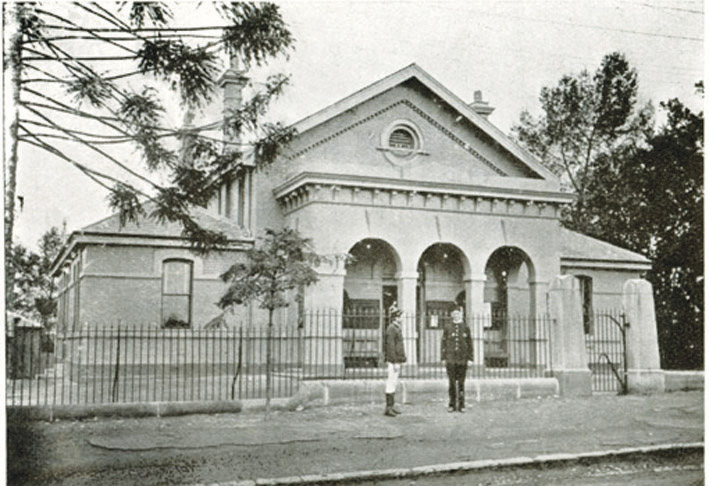
THE start of May 1882 seemed to bring out the anger in some of the men in the district, all due to the ‘demon‘ drink. At Penrith Police Court seven men and boys were sentenced for ‘obscene language’ – John Johnson, George Flood aged 19, Walter Wheeler aged 17 all on Windsor Road at St Marys. William Westland in High Street, and Joseph Wade outside Upton’s Boarding House on the High Street in Penrith, John Wilson and William Andrews at Emu Plains. Next came the extraordinary defeat of would-be champions of the aquatic world, where in days gone by the boating matches were regarded as tests of strength, the strength that is measured by personal power and endurance and that the strongest man was the sure victor. But with the result of the Intercolonial Boat Race in Melbourne where a crew was said to be absurdly of “low personal power” in comparison with their opponents, in the end it was not by a trial of brute force, but a lesson of skill and experience where the “light weights” of Sydney beat the stronger men of heavier calibre from Victoria. As usual at St Mary’s-South Creek the residents were complaining that the weather still continued very dry with no prospects of any downfall of rain, but they had some heavy frosts and if they didn’t see rain any time soon it would entirely destroy the grass crop for the winter and they were unable to feed their animals due to all the stocks being very low owing to the high price of fodder. Other problems were passengers at Mt Druitt station still waiting for a platform and being exposed to the elements for some considerable time to the cold rain, and with the area becoming a rising township they thought it was high time the Government made some provision for the travelling public. At Penrith Court a case of neglect arose when “our ever watchful and careful Sergeant Fowler” brought before the Court five young children, Thomas Burke (14), Sarah Burke (9), Margaret Burke (7), Andrew Burke (5) and Edward Burke aged only 3 years who were forwarded to the police by Mr Hammond of the Valley Railway station where the children were found in a most filthy state in a hut on Mr W Dean’s estate about two miles further on the Valley Road with some rotten beef in the hut and no bed clothes. The children said to the Sergeant that their mother had died in the Sydney Infirmary some time ago, and last month their father went to Sydney telling them that he would come back. Mrs Hammond sent food to the children for some days by the eldest boy. They were taken to the station to Mr Rae’s house. The Sergeant told the Bench that the eldest boy had obtained as much food as he could for the rest and had gone without himself and he was very emaciated and found it a difficulty to lift his little brother who fell asleep in the Court. The Bench recommended that the children be discharged and sent to the Benevolent Asylum under the care of Sergeant Fowler who asked for a warrant for the arrest of the father of the children and Sergeant Fowler brought before the Court Andrew Burke charging him with deserting his child Edward Burke at the Valley. This was the first case held in the new Penrith Court House and the prisoner the first in the new dock. His Honour Judge Dowling was the first Judge who sat in the new Court House and J J Riley was the first J.P. who sat on the Bench. J K Cleeve, Esq., was the first J.P. who tried the case and Andrew (for child desertion) was the first person tried. John Price the Bailiff who was 25 years in the service asked his Honour that as he was getting old could his son be allowed to assist him that was immediately granted. Two boys Charles Buckland and Henry Carruthers about 9 years were charged “with having wilfully and maliciously thrown a stone through a railway carriage window”. George T Evans the prosecutor and the superintendent for Railway’s in NSW said he knew nothing about the case himself but he had witnesses to call and saw the break-van before it was repaired. Thomas Daws a guard on the railway was in charge of No 40 up-goods-train and remembered a stone coming through the break-van windows. The stone passed through two windows and within six feet of where he was standing. Sergeant Fowler was sitting on the opposite side of the van to him when the broken glass fell about three feet above Sergeant Fowler’s head and he looked out to see where the stone came from and saw Buckland on the centre of the bridge rising up from his knees. The second boy Carruthers was on the other side of the bridge hiding behind a post. Thomas did not stop the train on account of the window being broken but he had to stop it at the crossroads (Kingswood) that was close by and Sergeant Fowler went back after the boys as soon as it stopped. It was with regret that even though many cases of a similar nature have occurred, the Department had stuck up posters in conspicuous places offering a reward for information that would lead to the conviction of offenders and the Bench would make an example of these boys as it was the first time they had been able to catch the offenders in this way. The Bench then committed the boys to trial at the next Quarter Sessions held at Parramatta in October. Bail was allowed to each at £40 and two sureties of £20 each. Also, at the police court Henry Robertson was brought before Dr Bond and Mr J K Cleeve J.P’s., charged with embezzling the sum of 15s. (shillings) money belonging to Alfred Colless and Co. The case was a lengthy one owing to the number of witnesses and the length of their evidence. The prisoner on this charge was committed to trial at the next Quarter Sessions to be held in Parramatta, bail was allowed in the amount of £25 for himself and two sureties of £25 each. The prisoner was then charged on a second count of embezzling 20s, also money belonging to his employers Alfred Colless and Co. The prisoner had made out a false account and delivered it to Edward Paskin who had an account with the firm, Henry obtained a £1 payment on the account and he gave a receipt. The money was never handed over by Henry that continued the proceedings against him. On this charge Henry was also committed for trial with bail being allowed for £25 and two sureties of £10 each. Henry was taken to Parramatta that same afternoon and when he arrived on the platform it was found earlier that another charge of passing a valueless cheque to the amount of £3 was pending against him and he was remanded for this trial also. (apologies to family members who recognise their loved ones).
Sources: Nepean Times 5 May 1882, page 3, Nepean Times 12 May 1882, page 4, Nepean Times 19 May 1882, page 4.