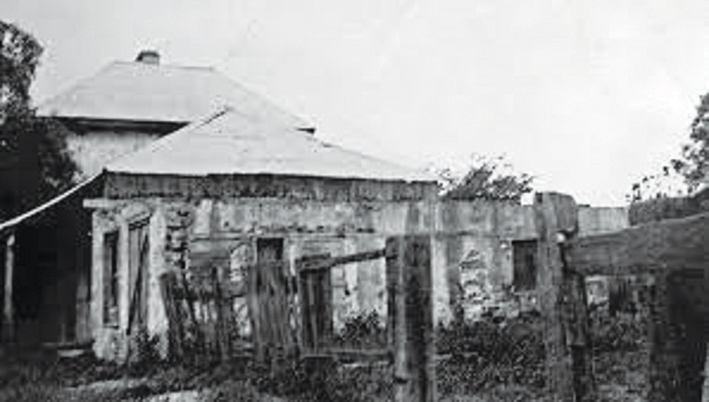
Photo of the original Governor Bourke Inn curtesy of Blue Mountains Library
By Lyn Forde – President/Research Officer of St Marys & District Historical Society Inc.
DINAH Fanny Jones of ‘’Telopea” Belmore Street in Penrith was the wife of John Jones and was born in January 1845 in the town of Lawson in the Blue Mountains to parents Henry and Sarah Wilson (Affairte). In June 1869 she married John at St James’ Church, Sydney and soon afterwards they settled in Penrith. Dinah’s birthplace was the old ‘’Blue Mountain Inn” that was first licensed by Henry in 1840. The inn was one of the few two-storied buildings of the historic early days and was the place of Dinah’s early childhood and years before the telegraph and railroad lines crossed the Mountains or even arrived in Australia (1879). The original two-story inn was accidentally destroyed by fire and later rebuilt as a one-storied building and Henry and Sarah continued to run. They were among the leading pioneers of the Lawson district. In those far remote years the mail and passenger coaches from Parramatta to the outback townships were the best means of travel. It was the wild, heroic, formative era with promise and on the verge of expectation of the great gold discoveries on the Turon. Dinah was their juvenile observer and saw the pristine misty valleys and mountain ranges in all their virgin splendour. In 1915 it seemed every ‘’approachable’’ ridge had its hamlet or town, its Lawson, Springwood or Katoomba with its urban institutions that were civic tributes and monuments to the genius toils and foresight of the pioneers who laid their foundations by their colonising effort of years ago. A young Dinah left Lawson with her parents in 1850 travelling enroute over many parts of the first Government road over the mountains, built under the supervision of William Cox in 1814. On coming to Penrith in 1850, Dinah’s father Henry took over the business of the ‘’Governor Bourke Hotel”, the historic building and in 1915 once occupied by Arthur Bennett situated at “Riverside” Penrith and immediately overlooking the Nepean River. A notable fact was that both these historic places, the Blue Mountain Inn (Lawson) and the garden adjacent to the “Governor Bourke Hotel” (Penrith) was, in 1915 still in the possession of the Wilson-Jones family, being the fourth generation there. Several of the original mulberry trees and an almond tree of the old orchard were still bearing fruit in season. “Governor Bourke Hotel” was originally built by Charles Wilson the brother of Henry and the building still stood in 1915 being lived in by the Bennett family for close on 80 years. During the Wilson family’s occupancy of the hotel the flood of 1867 occurred. A flood of such magnitude it was safe to say never previously known in the Nepean District. The flood waters rose to the top balcony of the hotel that stood at least 50 feet above the riverbank and played havoc with livestock and property on both sides of the river that caused much erosion of the bank. Dinah said that the old line of the riverbank known to her in girlhood had been completely swept away and the old cattle tracks here-and-there obliterated. The hotel and its vicinity were naturally hallowed ‘’ports of call’’ and haunts of golden memories for Dinah. A Russian naturalist named Stein claimed he had seen gold-bearing ore while on a 12-day trip to the Blue Mountains in March 1820 but many people were sceptical of his claim at that time. In 1841 Reverend William Branwhite Clarke found gold at Coxs’ River on the road to Bathurst and in 1843 he spoke to many people of the abundance of gold likely to be found in the colony of New South Wales. Ten years later a delighted Aboriginal prospector found a large gold nugget in the Turon River and Dinah remembered in her girlhood the nightly camps and the drays of the wayfarers bound for the diggings stretched for a mile or more on either side of the river at times, and the tremendous procession of the eager gold seekers passing with every form of vehicle from four-in-hand gigs, waggonettes, spring-carts, bullock drays, wheelbarrows right down to ‘ Shank’s pony’’ the only ‘’vehicle’’ that thousands of eager diggers could use to reach the diggings of the west and on the tail end after the diggings had been in progress for some time, there came a horde of “jabbering Chinese”, the vanguard that spread over the fields of NSW and Victoria despite the opposition of the disgusted white diggers. The Chinese survived the insults and banishment and returned again as the lucky fossickers of many worn out claims. In the mid-1860s two woollen mills were in full swing on the Nepean, Raynor’s on the Emu side and the shell of the Penrith Company’s Mill standing in a fairly state of repair by James Blaikie’s property on the eastern bank. The vague memory of the manufactures of the past whistled through the empty quarters of the relic of the mill that was still standing in 1915, one of only three woollen mills in the whole State at that time. The old-time bushrangers loomed largely in the formative years of Dinah who became a bright and interested witness. She remembered in her girlhood having the somewhat dubious pleasure of an “unrehearsed’’ interview with the notorious bushranger John Peisley who was executed in Bathurst Gaol in 1862. Accompanied by her young brother Charles they were proceeding across the river bridge towards Penrith one morning when they were confronted by Peisley who requested that she returned to the hotel to supply him with food. He detained her brother as hostage while waiting her return. As it was impolite to argue the point with a hungry armed outlaw Dinah set out and returned with Paisley’s requisitioned staples. Needless to say, the unwelcome guest soon made tracks for parts unknown and, of course, Dinah and her brother were most happy to be rid of his dubious company. Dinah also mentioned that she had also seen bushranger “bold” Jack Donohoe who she described as a small wiry-looking fellow who had great aversion to be seen in the company of the police, and as tradition and local knowledge declares the police kept a very private eye on Donohoe’s Cave in the foothills overlooking the western bank of the Nepean. (But this memory would have been impossible as he was killed in September 1830 at Bringelly, NSW before she was born). Dinah was the mother of our “Master Tanner” Frederick Charles Jones who had his tannery at Stott’s Creek, Werrington. Dinah died in July 1915 at the age of 70 years and is buried in St Stephens cemetery, Penrith.
Source: Trove-Nepean Times, Anglican Parish Registers, Ancestry, NSW Births, Deaths &Marriages, Wikipedia.