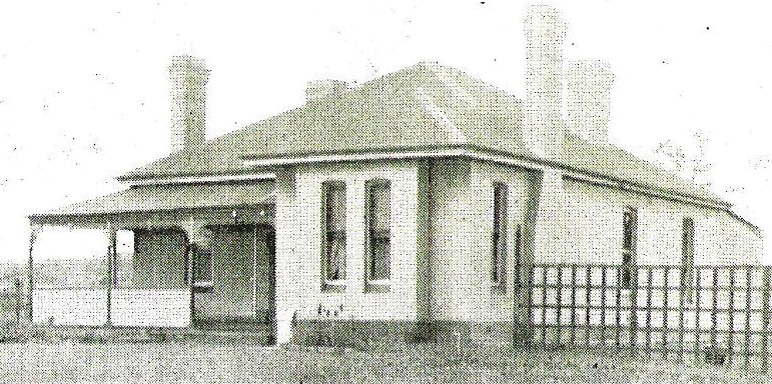
Photo of the rectory in Gidley Street – Original Unknown
By Lyn Forde – President/Research Officer of St Marys & District Historical Society Inc.
AT the Easter meeting of the St Mary Magdalene church at St Marys in 1885, a resolution was passed stating that a rectory should be built in the parish and in that year the Honorable Philip Gidley King later donated two acres of land and the conveyance was signed on November 8th 1888. During the previous year His Lordship the Primate Dr Barry visited St Marys and laid the corner stone of the Church of England Parsonage to the delight of about 200 residents of the district and members of other churches. Apparently, the festivities were hastily arranged to the point that “a member of the press had to make a writing desk out of a stack of bricks”. The Choir sang several selections and the following clergy present were:- Dr Corlette and Reverend’s R L King (later Canon), A C Corlette, Baber, Wheeler, Spooner, Fryer and Tate. A platform had been erected at the south-west corner of the building for the accommodation of His Lordship and a few other gentlemen. The Architect of the Parsonage was Mr Arthur Blackett of Blackett Brothers Sydney and the Contractor was Mr A M Allen. The corner stone of the building bore the inscription A.D. 1897 which reads:
– The Venerable Archdeacon of Cumberland, R L King.
The Rev G Brown, Rural Dean.
The Rev A C Corlette, first incumbent of St Marys and St Albans.
Churchwardens: John King Lethbridge, William Beacroft, William J B Neale.
Sidesmen: George Turner, Thomas E Dryhurst, James Gow, John Herford
Joseph H Sainsbury, George Bennett, John Stevens.
Sexton, Henry Burgess.
Alexander M Allan, Summer Hill, contractor.
Robert Robinson, Hon secretary, building committee.
The Bishop preached at the church in the evening to a crowded congregation and the commemoration stone was unveiled by Reverend A C Corlette who was to be the first clergyman to occupy the Rectory when it was built. The stone originally formed part of the old private observatory alongside Dunheved near St Marys that was the home of Anna Josepha the widow of Governor King. In 1931 a Building Committee was appointed with a loan of £200 and tenders were called for electric lighting of the Rectory. The Jubilee year of the Gidley Street Rectory was commemorated by a special gathering in the grounds on a Saturday in October 1937. The rectory at 34 Gidley Street was demolished in May 1957 as the building became uninhabitable with the walls cracking and plaster falling off and the movement of the ground was just too much for the old structure and on the advice of the building inspector from Penrith Council and Messrs. Collier Madge who were the building consultants from Sydney, it was decided to recommend to the Archbishop that the building needed to be demolished. The Archbishop replied saying that Archdeacon F W Tugwell and a builder Mr R B Ashley had also recommended the demolition as it would be uneconomic to spend further sums of money patching it up. In the emergency the rector and his family found it necessary to vacate the premises. The parish council of St Marys called for tenders for the demolition of the building and the clearance of the site. It was anticipated that the new rectory would be built on a new site near the church. At that time the scroll was found giving details of the history of the rectory and was signed by the Rector and churchwardens and around ninety past and present parishioners that had been placed in a sealed tube and deposited by John King Lethbridge in a prepared cavity in the stone along with a copy of the Sydney Papers, coins of the realm and the Nepean Times Newspaper that had been sealed in a bottle. Also enclosed was a scroll on engrossed parchment that was the handiwork of Mr T E Dryhurst of St Marys Public School that read “This corner stone was laid by the Right Reverend Alfred Barry, Bishop of Sydney and Primate of Australia on the 18th November and during the jubilee year of Her Most Gracious Majesty Queen Victoria in the year of our Lord 1887 and during the Governorship of the Right Honorable Charles Robert Baron Carrington a member of Her Majesty’s Most Honorable Privy Council, Knight Grand Cross of the most Distinguished order of St Michael and St George, Governor and Commander-in-Chief of New South Wales and Its Dependencies.”
Source: Nepean Times – November 1887, Jan 1958.