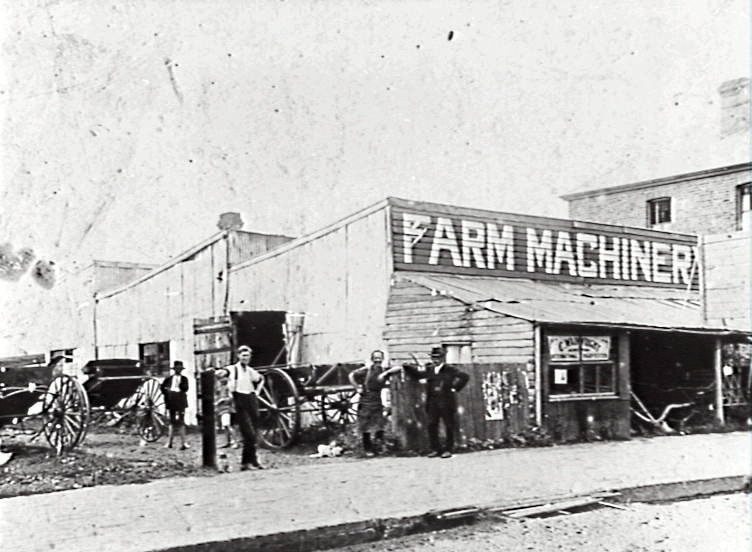
Photo of Claude at his blacksmith shop on High Street Penrith 1921 courtesy of Penrith Library.
By Lyn Forde – President/Research Officer of St Marys & District Historical Society Inc.
JAMES Wainwright was born in 1808 in England, his occupation was a school master and he died in 1863 at Colyton and is buried in St Mary Magdalene cemetery at St Marys. James married Hannah Clack, the daughter of Thomas Clack and Ann Topping in July, 1827 in St George’s church, Littleport, Cambridgeshire, England. She was born in March 1804 and baptised in the same church where she married James. She died in June 1880 in St Marys and is buried with James. Their son Samuel David Wainwright was born in 1834 at Upwell, Cambridgeshire in England and married Elizabeth Burdus in July 1854 in the Parish Church, Sneinton, St Stephen, Nottinghamshire, England. Elizabeth was born in 1834 in Nottingham and the daughter of William Burdus and Ann Gillian. While in England Samuel learned the trade of blacksmith. Samuel, Elizabeth and two-year-old daughter Rebecca came to Australia arriving in February 1857 on the “Hindostan”. In Sydney he met Thomas Smith who employed him as a blacksmith at Colyton. In the early days the carting business to outback towns, along with the sheep and cattle runs was in its heyday and the coaches and wagons were the vehicle of traffic trade over the Blue Mountains that kept Samuel busy in shoeing heavy draught stock and coach and saddled horses. The railway had only been laid on the stretch from Parramatta to St Marys by 1862 and Samuel made a number of the large double hinges for the level crossing gates at St Marys railway station around that time. Granny Cochrane, who was a girl of thirteen, arrived with her parents in Sydney on St Patrick’s Day 1856 and after a week she left Sydney with her mother on the 1 o’clock coach for Penrith. She said that “on the journey we went along alright until we nearly got to the “Red Cow Inn” at Colyton kept by Thomas Smith when it was found the coach had broken a wheel and Mr Samuel Wainwright the blacksmith was roused up to mend it”. When Thomas Smith left Colyton to take over the “Red Cow” hotel at Penrith, Samuel brought property at Colyton and started as “mine host” in his “Horseshoe Inn” in 1871. Elizabeth died in 1905 and Samuel died in 1917 at St Marys and both are buried in St Mary Magdalene cemetery. Their son James was named after Samuel’s father and was born in 1858 in Colyton and he married Emily Faith Lawrence in St Paul’s Church at Redfern in 1883. She was born in 1863 in Penrith, the daughter of Elias Lawrence Wainwright and Eleanor (Ellen) Boots. James died in November 1928 at Penrith and Emily died in 1951 also in Penrith and both are buried at St Mary Magdalene cemetery. Their son Claude Leswell Wainwright was born in Penrith in 1889. In 1912 he married Florence Isabelle Harvey in St Mathews Church at Botany. She was born in St Marys in 1893, the daughter of Frederick Grenville Harvey and Ada Constance Blackmore. In 1915 Claude announced that he had commenced business as a farm implement maker, coach painter and general blacksmith in the premises that had been occupied by Mr J Cook in High Street West at Penrith and he would also repair all classes of implements and take old ones as part payment for new. He called his business “The Independent Farrier” but in June 1916 he decided to free himself from the Master Farriers’ Association of NSW. With Agricultural Work at lowest rates and coach painting a speciality he now called his business “The Farmers’ Friend”. In February 1917 during WW1, Claude came up with a Penrith invention. Briefly, Claude’s invention that he called ‘’The Peeper’ or ‘Lifesaver” was a model designed to enable an observer to study the enemy’s positions or the surrounding enemy country without risk of being found out by either rifle, bomb or shrapnel attack. “The Peeper” designed to fit over the observer’s head at trench level and narrowed at the observing end with an oblique eyes-slit or aperture that can be improved by the addition of a small glass lens or without the lens. The material for war observation purposes would be of the best tempered steel, and Claude claimed that it would be found impervious to any sort of heavy gunfire. The apparatus of a concave shape and is about 2ft-6in in length and of sufficient depth to cover the head of the soldier observer. It would fit into the top of the trench as a solid part of the scenery and would be of an earthen colour so as to keep “Fritz” in the dark as to its whereabouts. It was believed that the sniper could fire ‘The Peeper’ and the eye-slit was of such small scope that a rifle bullet could not possibly penetrate it. The Nepean Times said that “they had seen a model of the clever invention called ‘“The Peeper” designed for the protection of soldier observers viewing the enemy’s lines from the trenches and they had much pleasure in stating that the name of Claude Wainwright blacksmith, would henceforth be known in the honour roll of Australian inventors as to all intents would be of great assistance for observation purposes for the men in the trenches and that they believed would cover a long felt want in that direction. Claude Wainwright had patented his invention that has been well thought of by returned soldiers and military officers and we hope “The Peeper” will be found as effective as its design seems to warrant”. In July 1920 Claude had partnered with Ernest James Joseph Jones now calling their business “Wainwright And Jones” but in 1921 he had taken over the business and would carry on alone, now calling himself a Coachbuilder and Blacksmith. His wife Florence died in June 1934 and Claude died in Kingswood in May 1983 and both are buried at Penrith General Cemetery (Anglican section). P.S:- I contacted Jane Peek the Curator of Military Heraldry at the Australian War Memorial to verify if Claude’s invention was ever used in WW1 and she said “We have no record of it being used, and no examples in our collection. Both the First and Second World Wars prompted enthusiastic inventors to create items that they thought might help the war effort. The vast majority were never adopted, including some that went into limited production. I was unable to find any record of Claude in National Archives or a record of a patent application from him”.
Sources: Nepean Times, Ancestry family information, NSW Births, Deaths & Marriages website, Find a Grave website, NSW Immigration records, Trove.