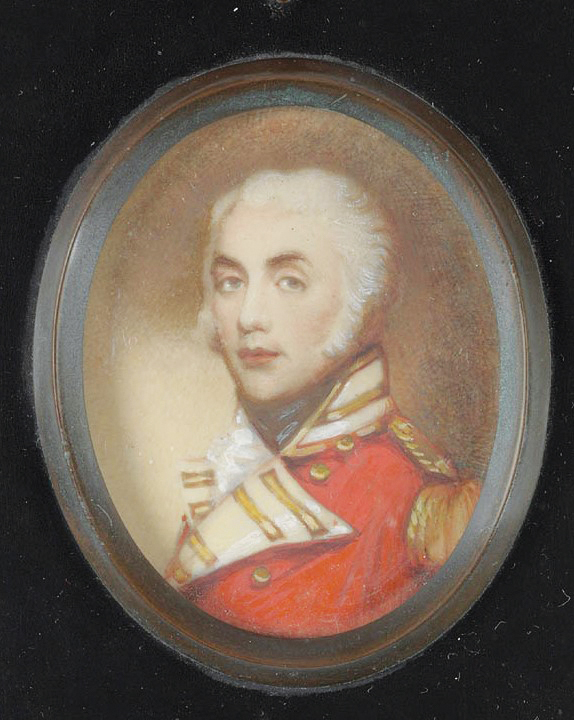
Watercolour of James Erskine courtesy of State Library Dictionary of Sydney.
By Lyn Forde – President/Research Officer of St Marys & District Historical Society Inc.
JAMES Erskine was born in September 1817 at Maryborough, Queen’s County in Ireland. He joined the army and served in the West Indies from 1791-1797 with the 22nd Regiment taking part in the San Domingo campaign in 1794 when he was gazetted to Captain. In June 1798 he was transferred to Ireland where he fought at the battle of Vinegar Hill and shared in the task of suppressing the rebellion. Transferred to the 48th Regiment in 1803 he was promoted to Major Erskine. In April 1805 he married Sarah Andrews of Cheltenham. He served in the Peninsular campaigns where he was slightly wounded in 1809 and later promoted Brevet Lieutenant-Colonel in 1810, and Lieutenant-Colonel in 1811. In August 1817 he arrived with his regiment in Sydney on the Matilda and was sworn in as Lieutenant-Governor of the Colony in September. In May 1818 he received a grant of 3,000-acres at (Melville) South Creek that he called “Erskine Park” and he was known for his kind treatment of his convict servants. In August 1821 an advert appeared in the Sydney Gazette giving notice that there was only one public road through Erskine Park, namely from North to South and commencing at Reverend Marsden’s land and ending at the entrance to Nicholas Bayly’s land and that anyone found trespassing or removing the fences would be prosecuted. This became a problem when the grants and settlers fenced in their land entitlements but left no passageway for those who lived in the area. In 1825 James went to Madras to re-join his regiment but he died of cholera four days after arriving there. By 1827 George Bunn who lived in George Street Sydney was the owner of the property that he rented out to Terence Murray Esq as a country residence with James Evans as the overseer. In June 1830 at the Supreme Court, Simon Hunt and Richard Baker were indicted for stealing sundry articles of wearing apparel the property of our Sovereign Lord the King at Penrith in April. A second account was laid, the property of some “person or persons unknown”. The Attorney General conducted the prosecution and Mr Therry appeared for the defence. The evidence in the case was the evidence of circumstances, or rather the evidence of inference as it appeared from the testimony of the witnesses that about the month of February it was reported that a man named Samuel Martin who was employed as a market man to Terrence Murray fell from a dray on the road to Sydney and was taken to the General Hospital where he died on the 26th the same month. So much of the evidence was merely a report, as none of the witnesses could say that the occurrence took place and had never seen Samuel Martin or knew that he was employed at Erskine Park?. It appeared however from direct testimony, that on or about the day that Simon Hunt was in the service of Terrence Murray he told Richard Baker that Samuel Martin had died in Hospital and “will not trouble this place anymore” and that Samuel had left his trunk in his charge but not the key. Simon Hunt said he had heard that his master settled with Samuel a short time before he left and that they might as well take what was left behind before anyone else gets it. The witness who spoke of having overheard this conversation went on to say that he saw Simon Hunt through a chink in the partition, break open the box with an axe in the dairy and take out some clothes consisting of trousers, waistcoats, a blue jacket and other articles similar to those produced before the Court. It further appeared on the evidence of a female servant to Mr Hook at Bayly Park that on or about the time stated in the information the two prisoners came to her master’s house at night with the clothes tied up in a bundle and Baker requested her to put them near the fire to dry for him when he returned which she did, but she did not see either of the prisoners again and the clothes were handed over to Terrence Murray at Erskine Park. A tailor residing in Sydney was then called on who proved he made the clothes shown to him for a man named Sam (he knew him by no other name) who lived up country and that he heard that he was dead and remarked at the time that he had lost money that remained due for Sam’s clothes. A clerk in the General Hospital was also called and said that a man named Samuel Martin was received into the hospital and died there on the 26th of February and he was buried at the expense of the Government. This concluded the case for the prosecution. Mr Therry submitted that the information could not be supported on the ground of uncertainty and that all the indictments were bad. The Attorney General contented that on the first count the information was good. The property of all intestates was property of the King until Executors were appointed and besides, property might be laid on the person by whom the expense of the funeral was defrayed, and it was in evidence that the deceased man Samuel Martin was buried at the expense of the Government. The court knew that robberies might be committed and parties convicted without it being possible to ascertain who the property belonged to and it would in such a case be sufficient to lay it on some person or persons unknown and be submitted that none of the witnesses on the present trial spoke with any certainty of the deceased. The Judge then summed up the evidence and the Jury retired and returned a verdict of Not Guilty. In 1893 at a St Marys Council Meeting in August, a petition from residents of Erskine Park was asking for Council’s attention regarding the state of the road, or rather what should be a road, namely the one leading from Erskine Park Road to Mamre Road and known as Page’s and Baker’s Lane that was impassable and was the only road they could take their produce to, and get supplies from St Marys unless they travelled by the Erskine Park Road to Mt Druitt that was also in a very bad state so, would Council take the matter into consideration and have something done to either one or the other of the roads at once?. It was signed by 11 ratepayers of Erskine Park. Alderman Cox moved that the petition be granted and Alderman Fleming seconded – all carried.
Sources: manuscript catalogue under J. Erskine (State Library of NSW), National Archives of the United Kingdom, Australian Dictionary of Biography, Ancestry, Sydney Gazette & NSW Advertiser, The Australian, Nepean Times.