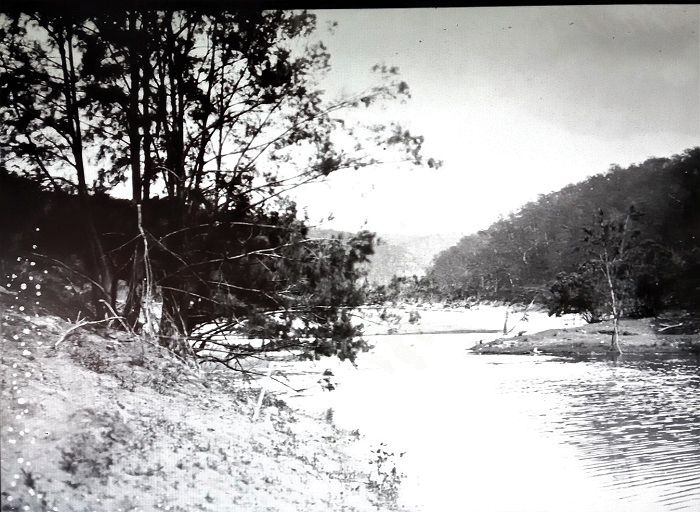
The 1930’s photo of Mulgoa Creek courtesy of Fairfax archives glass negatives online.
IN January 1894 a magisterial enquiry was held at the Penrith Court House by Coroner John King Lethbridge on the body of a man found in Mulgoa Creek. Sergeant Thorndike gave evidence that he went out to the Creek and found on the bank near an oak tree, a brown check tweed coat and vest and a straw hat in the water and the dead body of a man floating with his head half out of the water and with the help of others at the scene he recovered the body. The man was about 5ft 9in and well-built with fair complexion, dark brown hair, a short clipped thick beard and reddish-brown moustache, blue eyes, thick eyebrows and a broad nose. His body was dressed in a coloured cotton shirt, cotton undershirt, drawers, thick tweed trousers same colour as coat and vest, partly worn Balmoral boots and in the coat and vest he found a white cotton handkerchief, 2 knives, a bunch of 8 keys on a white metal chain, a briar pipe, matchbox, 2 pieces of tobacco, a box of matches, a small pocketbook, pencil, a hand fishing line, a piece of paper that was apparently the top of a race book. He found no money or valuables in the pockets of the trousers or anything that would lead to his identification. Dr Brady gave evidence and said that he was a legally qualified medical practitioner, practicing in and residing at Penrith and he viewed the dead body of the man at the hospital morgue and after shifting the body he found three superficial wounds over the left eyebrow and the tongue was partly protruding, the eyes were a light hazel or grey colour, the pupils normal and from the right ear blood was exuding but there were no external marks of violence as the exuding of blood from the right ear is usually indicative of a fracture of the base of the skull but he could not ascertain what was the cause of death without a post mortem. On manipulating the head, he found no rigor mortis, the head on the neck was quite flexible and on examining this he could find no external marks or fracture. It seems at this stage after some argument and several sharp words between Coroner Lethbridge and Dr Brady, the Coroner said that he saw no occasion for a post-mortem examination and he would “give his own opinion” and he did, and found as follows “From the evidence adduced, the deceased name unknown in the Mulgoa Creek in the District of Penrith in the Colony of NSW on the 17th January 1894 was found dead without any marks of violence appearing on the body and that death was caused by suffocation by drowning, but how or by what means he came to be drowned there is not sufficient evidence to enable me to say”. On the 20th January the way the magisterial enquiry ended gave rise to reaction from the public who did not like the way it ended as there was not the slightest evidence as to who this man was. He was respectably and cleanly attired and had the appearance of having a home somewhere. The body was well nourished but still there were no papers, letters or money, or was any of his clothing marked in any way to lead to his identification. When the body was first seen by the police there were some superficial wounds and blood that was exuding from the right ear, but there did not however appear to be any marks of violence or were there any traces of a struggle. Apparently that location was known only to old fishing hands and a stranger would not likely select such a spot for fishing. With the evidence given by Dr Brady at the enquiry it was thought that Mr Lethbridge should not have so hurriedly brought the enquiry to a close by recording as he did, an open verdict on his own account, especially as the medical officer stated distinctly that the exuding of blood from the right ear is usually indicative of fracture of the base of the skull, but it was impossible for him to tell whether such was the case “without a post mortem examination” and he added that he would make the necessary examination to not further delay the finding, but the Coroner would not consent. Mr Lethbridge may or may not have been right on the score of expense, as a post-mortem cost around three guineas, but with a view of really finding out if there had been any foul play, the examination should have been made so as to clear up the mystery at once. On 27th January a connection was found to the deceased when a gentleman came to Penrith and recognised the handwriting on the letters found near the deceased was that of “Lansdell”. He was well known and well connected and in receipt of remittances from England where he had a large number of relatives. The gentleman was well acquainted with the deceased and his relatives and had no hesitation in identifying him by the particulars given by the police and his clothing, as well as by the handwriting of several torn letters in the possession of Sergeant Thorndyke. The gentleman said he saw the man a few days before his body was found, saying the deceased was of an unusually quiet disposition and he could not swim. (Ed – On doing some further digging I found:- His name was Alexander Woodward Lansdell, born in Canterbury, Kent in 1846 to Henry and Julia Lansdell. At the age of 38 he came to Australia as an unassisted immigrant on the “Port Jackson” from London to Sydney in January, 1884 (3rd class), his occupation down as “Clerk”. (furthermore – The letters play a significant part in this story, because at the magisterial enquiry they were missing from the very well documented evidence collected and remained so after the enquiry, but somehow on the 27th of January they turned up when the “gentleman” came to Penrith and were found in the possession of Sergeant Thorndyke!!). One of the letters deciphered was from William Harding in Paddington, Sydney dated 15/12/1892 to William Cuddon (Jnr) in Christchurch, NZ on behalf of Alexander who was about to go to New Zealand in search of employment there. He had been out of employment for some time here working as a canvasser and traveller for Sydney firms. The part of the river where his body was found was called Elliott Creek, part of the Mulgoa Creek. The probate wasn’t released until 1898 in London to his brother Reverend Henry Lansdell, of personal effects and £91 and it gave Alexander’s address in Sydney as 55 Elizabeth Street. ACCIDENT OR FOUL PLAY?
Sources: New South Wales, Australia, Unassisted Immigrant Passenger Lists, 1826-1922, NSW, Australian Government Gazettes, 1853-1899, Ancestry, Trove, Evening News (Sydney, NSW), Nepean Times, Sydney Morning Herald, England & Wales National Probate Calendar (Index of Wills and Administrations), 1858-1995.