

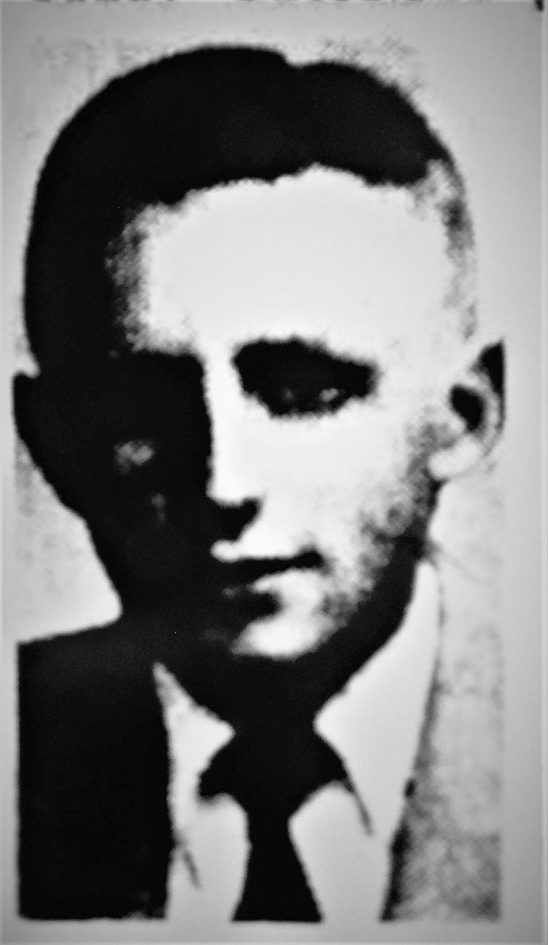
Newspaper photo of Peter from the Melbourne Herald
By Lyn Forde – President/Research Officer of St Marys & District Historical Society Inc.
IN October 1914, a group of young officers of the newly formed Australian Flying Corps met in Victoria. They decided that an Australian Aero club should be formed to be affiliated with the Royal Aero Club in London. The first President Major H.A. Petre was sent out from England to inaugurate a flying school for the Australian Government. Further development of the Clubs was delayed by World War I and in 1919 individual sections of the Australian Aero Club was formed in Victoria, New South Wales, Queensland and South Australia. In March 1926 the national aero club movement was formalised under the name of the Australian Aero Club Federal Council and consisted of representatives of the Victorian and New South Wales Clubs only. In 1929 a new Constitution was adopted and the name changed to the Associated Aero Clubs. The primary object of the Clubs was initially to develop interest in flying throughout the Commonwealth, with particular attention paid to Aerial pageants, air races and public receptions for pioneer aviators at the end of historic flights. These were accompanied by flying displays and were well attended. As WW2 began to threaten in the 1930s, the Clubs began to realise their defence potential and they made strong representations to the Federal Government for financial assistance to support pilot training at a reasonable cost for the individual. When war finally broke out in 1939 several of the larger Clubs were turned into elementary flying training schools and provided the instructors, aircraft and ground maintenance facilities to train cadet pilots for the Royal Australian Air Force that allowed the RAAF to concentrate on intensive instructor training. In December 1945 while on a local flight a single engine aircraft went out of control and spun in between Prince Henry Hospital and Long Bay Gaol in south Sydney. The aircraft was destroyed and the pilot Miss Betty Faux (30) an electrical worker of Kensington was killed in this aircraft rebuilt during the war by the Aero Club of NSW at Mascot when replacement aircrafts required desperate measures. The plane was based on the wreck of a Moth VH-UHQ that was badly burnt in a hangar fire at Wagga in December 1939. The rebuilt aircraft was designated a DH.60GIII Moth Major that was originally built by De Haviland and flight tested in December 1943. It continued to fly with the RACNSW for almost exactly two years until the fatal crash. In 1948 the name changed to the Aero Club Federation of Australia and during 1960 the prefix ‘Royal’ was granted by Her Majesty and the present title adopted. In March 1954, Peter Williamson Eastaway (28-single) of Cremorne, a student pilot of the Bankstown Royal Aero Club died from the effects of injuries accidentally sustained when the Tiger Moth plane he was flying hit an electric high-tension wire stretched across the Nepean River and the plane fell into the river at Agnes Banks. Peter was taking his “A” class cross-country license test. At the inquest held at Penrith Court House, the District Coroner Mr N C Gardner CPS found that no blame was attached to the Club. Constable Ellis of Penrith said that he went to the Western bank of the Nepean River at Agnes Banks and saw an aeroplane submerged in the river close to that bank and saw Peter lying cold on a blanket on the riverside. Penrith Ambulance then took his body to Nepean District Hospital where Dr Barrow examined Peter’s body at Penrith Morgue. He said that in his opinion, death was due to a fracture of the skull. Flying Instructor Tasman Herbert Dalton of the Royal Aero Club of NSW said that Peter was a student pilot and his flying experience was approximately 45 hours, made up of dual and solo flying, approximately 21 hours would have been the solo flying but before Peter could be tested as a pilot, he would have to have a minimum of 40 hours total flying. He said that Peter was to be tested for his licence the next day by him as he had supervised Peter’s flying instruction and from his experience he would say that Peter had shown sound average ability and that he was on the premises when the aircraft was ready for Peter to fly that day, but he did not see the actual departure. He also said that he had flown that aeroplane that morning and it was perfectly normal in operation and the course Peter was directed to fly on that day involved flying directly along the Nepean River and Peter was on his second cross-country solo flight. Eric Buhois Spooner an accountant of Wahroonga said that about 5.10 p.m. in March he was standing at the side of a house on the western bank of the Nepean River at Agnes Banks when he saw a yellow single-engine aeroplane travelling in a northerly direction and following the line of the Nepean River at about 160 to 200ft and it appeared to be running normally from the sound of the motor and was descending at an angle of about 20 degrees when it levelled out at about 60ft above the treetops and flew on that course for about 100 yards. Eric said he saw sparks coming from the front of the plane and he heard a screeching noise that he later learnt was the cables parting, and the left wing dropped pointing to the ground and the nose of the plane rose and he saw the plane falling but did not see it after it fell below the level of the trees. He ran in the direction of where the plane fell and located it near the western bank and he noticed that the cockpit was about two feet underwater but Peter was well under the water, he freed him from the cockpit and cut the straps but the shoulder straps were quite tight, and so tight that Eric had to put a little force on them in order to get the knife under and after he had freed Peter he was placed in a rowing boat and taken to shore. Stanley Lintott, a farmer residing at Springwood Road in Agnes Banks said he was sitting on the veranda of his home facing the Nepean River when he saw the plane fall into the river after hitting high tension wires. He rowed down with his brother to the plane and he was present when Eric Spooner released the pilot from it and helped to place Peter on the bank and said that he carried out artificial respiration in case that it was necessary. Peter’s parents George & Lillian of Holt Road, Cremorne were at the inquest when the coroner said the he was satisfied from evidence in this most unfortunate accident that all adequate steps had been taken by the Aero Club, both in the instruction of Peter and in the checking and preparation of the plane and that the aeroplane was in an airworthy condition and it was a most unfortunate happening that can only be ascribed to the failure of the pilot Peter to observe closely the instructions that he had been given. Peter’s funeral was at St Augustine’s Church, Neutral Bay and then to the Northern Suburbs Crematorium.
Sources: Bureau of Aircraft Accidents Archives- Ed Coates, Nepean Times


