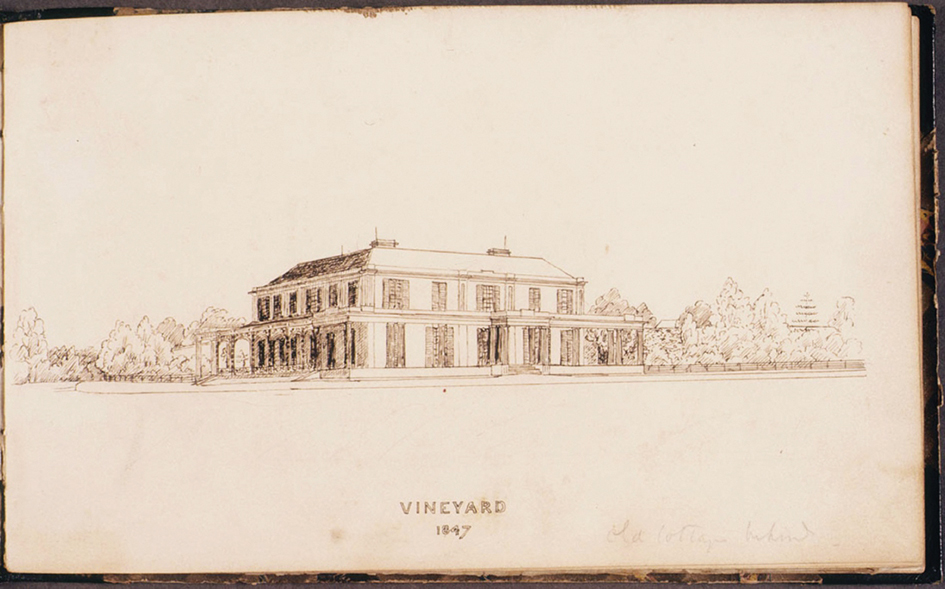
Photo of Vineyard Cottage 1847 courtesy of Sydney Museum
By Lyn Forde – President/Research Officer of St Marys & District Historical Society Inc.
THOMAS was born in Devonport, England in 1781 to parents John & Elizabeth Easterbrook (Doidge). In August 1801 at the age of 20 Thomas married Mary Ann Coombe by banns at Buckland Monachorum in Devon. Mary Ann was born in 1785 at Saltash, Cornwall in England and had received a good education and Thomas had also received some education. He was a miller by trade, receiving an apprenticeship in his early years. In 1820 he appeared before the Devon Assizes at Exeter where he was accused of stealing and killing a ram sheep valued at 40/- from John Hyne at Charles, Plymouth. Physically Thomas was said to be 5’6’’ with grey eyes and black hair. His appearance at the Assizes he pleaded innocent but was found guilty and sentenced to be hanged that was later changed to transportation to Australia for life. In October Thomas sailed for Port Jackson aboard the convict ship “Prince of Orange”. Thomas joined the ship at Spithead in Portsmouth a few days before sailing. The male convicts came from all over England and Ireland, most were farm labourers or tradesmen such as blacksmiths, twine spinners and carpenters. At sea they were guarded by a detachment of soldiers of the 34th Regiment of the 17th Foot. The guards worked independently of the ship’s crew of 30 men. From Portsmouth and down the Atlantic into the roaring forties the ship sailed around the bottom of the globe to Australia and through the southern latitudes where symptoms of scurvy began to appear, but quickly went away with the use of lemon juice. They arrived at Sydney Cove in February 1821, but Thomas remained onboard for a further five days when he was transferred to a smaller vessel and travelled to Parramatta up the Parramatta River. He was among 20 men shipped to Parramatta that day, when Thomas and four of his shipmates were met by Hannibal Macarthur their new employer. In August 1815 the Macarthur’s purchased the “Vineyard” from Phillip Schaefer that was sitting on the north bank of the Parramatta River. As part of his business Macarthur owned and operated a large water mill that sat at the confluence of the Vineyard Creek and the Parramatta River. He provided a milling service for His Majesty’s Stores at Parramatta as well as grinding his own grain. Competent millers were in demand in the colony in the 1820’s and Thomas’ skills were to be put to good use. Thomas had been in Australia two years when in February 1823 at the recommendation of Hannibal Macarthur and the Governor Thomas Brisbane, Thomas was included in a “List of Applicants” to have their wives and families sent out to the colony at the expense of the Crown. At this time Mary Ann and their two youngest children, Abraham born in 1813 and Isaac born in 1820 were living at Stoke Demerel at Plymouth Dock. Mary Ann and the children appeared to have lived in that vicinity from the time of Thomas’ transportation. Their eldest son John stayed in England but later committed a crime that saw him convicted and sentenced to NSW. By the time Governor Brisbane’s list reached England on the ship “Surry” an arrangement for Mary’s passage made in 1823 had almost passed, but in December Mary Ann, Abraham and Isaac joined 53 other dependents of convicts aboard the ship “Brothers” at Portsmouth. The ship was a female convict transport and as well as the dependents it carried 89 female convicts. Many women were seasick for the first few days at sea but apart from stormy conditions in March 1824 the weather became very mild and the voyage relatively comfortable. After the long voyage down the Atlantic and across the southern ocean they finally reached Hobart where 50 of the female convicts disembarked and then they sailed for Sydney Cove arriving in May. Mary Ann petitioned Sir Thomas Brisbane the Governor of the Colony for the release of her husband as it was common practice for convicts to be assigned to their wives once the families were reunited, and it would appear that Mary Ann left England with some such understanding, and she wrote: “Previous to my leaving London I was informed at Earl Bathurst’s Office that on my arrival in Australia my husband would be assigned to me and thereby have an opportunity of providing for me and my family”. The Colonial Secretary in turn wrote to Hannibal Macarthur at Vineyard Cottage in July 1825 asking him to discharge Thomas. Ten days later Macarthur replied saying that he was willing to discharge Thomas if he could be “provided with a man capable of taking his place”. The family then reunited at Parramatta and it was apparent that Thomas’ skills were in demand and his job secure. He was receiving a salary of £20 per year and was part of the large estate. Hannibal Macarthur had established a very comfortable estate at “Vineyard”, however he shared little of his wealth with his assigned servants. In a later letter to the Colonial Secretary, Mary Ann complained of her situation saying, “If I thought before I left my Country and my friends that I should have suffered so much poverty, I positively would never have made such a long voyage, notwithstanding the affection I bear my husband”. Thomas was finally given his independence and the family moved to Black Wattle Swamp in Sydney where he died in 1837 at the age of 56 and was buried in the Old Devonshire Street Cemetery. John was granted a ‘Certificate of Freedom’ in August 1831 and remained in Sydney until his death in April 1843 at the age of 40 and was buried with Thomas, but later the monuments were moved to the Bunnerong cemetery at Eastern Suburbs Memorial Park, Botany. Isaac married Ann Malady in February 1840 in Sydney and later around this time the family moved to Singleton where he died at Patrick Plains in July 1864 aged 48 and is buried at Whittingham Cemetery Singleton. Abraham left the Vineyard and moved to the Richmond area eventually becoming a miller at Pitt Town on the Hawkesbury River. He married Ann Miles at Richmond in 1835 and they later moved to Mulgoa. He died in October 1880 and is buried at St Thomas’ Church of England Cemetery. According to Ancestry’s Australian Death Records Mary Ann died in 1850 at the age of 65 at Mulgoa and is buried in St Thomas’ cemetery.
Sources: Australian Royalty website, Family Search (Mormon website), National Library of Australia, Trove, 1828 Census, Australian Marriage Index, Ancestry family information.