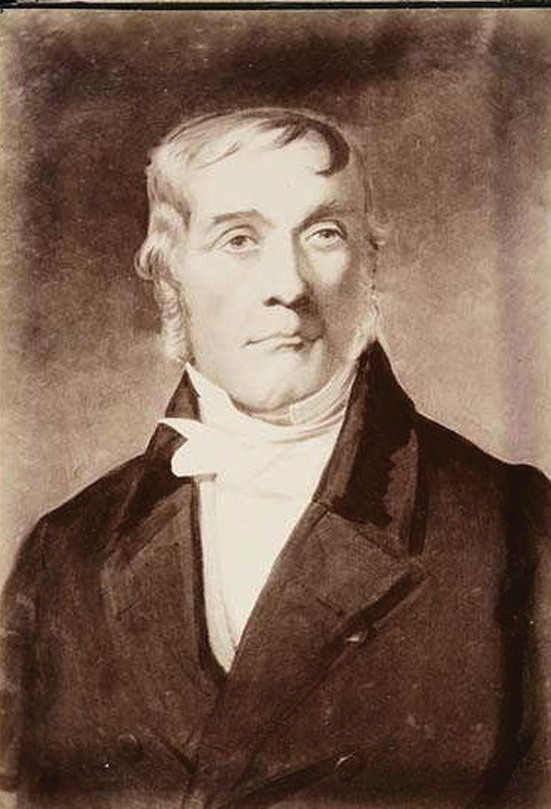
Photo courtesy of Faithfull Family collection
By Lyn Forde – President/Research Officer of St Marys & District Historical Society Inc.
WILLIAM Faithfull was born in Hampshire, England in 1774. He arrived in NSW on the “Pitt” as a Private in the New South Wales Corps, Captain Joseph Foveaux’s company in February 1792. In 1795 after being ordered by Quartermaster Thomas Laycock to shoot one of John Boston’s pigs that was trespassing on Captain Foveaux’s land he was sued by John Boston but both Laycock and Faithful were found liable for the damages. On his discharge from the army in 1799 he was employed by Foveaux in the management of his farms and when Foveaux left the colony in 1801 he settled part of his flock on William who became a farmer when he received a grant of 25 acres at Petersham Hill and a further 1000 acres at Liberty Plains. William married Susannah Pitt by Samuel Marsden in November 1804 at St Johns Church Parramatta with the permission of His Excellency Philip Gidley King, in the presence of Thomas and Hester Pitt who both signed the register. William made his X mark and Susannah signed the register as ‘Susanna Pitt’. In January 1805 an accident happened at Richmond Hill where he fell on the prongs of a pitchfork that entered the lower part of his belly and passing upwards through his right side that could have killed him, but he recovered. The grant at Liberty Plains in 1808 was made on a recommendation by Lord Nelson in favour of William’s wife Susannah who was a daughter of Mary Pitt, née Matcham a relation of Lord Nelson. Governor Macquarie regranted the land to William at Liberty Plains in 1811 and William later exchanged it for better land at Jordan Hills in the Richmond district where he became a prominent settler gradually extending his holdings, Also, in June 1805 in the Court of Civil Jurisdiction an action was brought by James Morris against William to recover damages for passing around false information to damage his character. James stated that he had for a length of time maintained a friendly demeaner with William, who was residing at the Hawkesbury but had found a home in Sydney in his house without any charge whatsoever, but sometime since William had the misfortune to receive violent harm from which it was said that he was not likely to recover, and as soon as James heard of the accident he went to the Hawkesbury to find that William had happily recovered and had gone to Sydney and put up again at his house as before. After William’s return to the Hawkesbury, James heard that William had contrived an account against him to the amount of £200 and more, whereas upon checking the accounts James found there appeared to be nothing due on either side and he concluded by saying that as a person in trade his reputation was injured by the accusations that found its way throughout the different settlements which could only be wiped away by this enquiry into its origin and called for evidence to prove that William had said that “he was somewhat alarmed to hear at Sydney that at the time of his dangerous illness, James or somebody belonging to him had positively affirmed that he had him for upwards of £200 that his property was sufficient to satisfy.” William admitted having used such expressions but would prove they were not fabricated by him, having been circulated and mentioned to him by a respectable person who, being called upon by William, admitted it. The report was then traced to various persons, who anxious to rid themselves of the burden, pitched it on the shoulders of others who followed their example in disposing of it until it fell upon an eight-year-old child who, when challenged by her parents, totally denied it. The Court thought it time to interfere and firmly demanded of James what his chief end was bringing it to court?. Had it been for the recovery of damages? as none had been made to appear, and William had given up sufficient proof that the scandal had not originated with him. If however, he only sought to rescue his character from gross and villainous imputation, he had effectually done so by running down the calamity and prohibiting the shadow of presumption, that it could have been sanctioned by any such expressions from himself or any of his family. William was ready to do every justice to James who he always esteemed and made a declaration which was accepted as satisfactory. Court adjourned with each paying his own court costs. In 1820 Susannah died and he married Susannah’s sister but that marriage was annulled, then he married Margaret Thompson of Bringelly in November 1821. Margaret died in July 1842 then William went on to marry Maria the eldest daughter of Archibald Bell of Belmont in June 1843 by special license at St Peters Church Richmond. William died of disease in April 1847 aged 73 and Maria in May 1859. He is buried in St Peter’s cemetery, Richmond with his three wives. In 1826/27 Anthony and Elizabeth Rope occupied land on William Faithful’s property that was near the junction of Ropes Creek and South Creek and between Shanes Park and Dunheved. They were still farming there in 1828 and at that time had 11 acres of land, all cleared and cultivated and five horned cattle. The area is now known as the suburb of `Ropes Crossing’ and the creek is called “Ropes Creek” (a small tributary east of South Creek) The `Gazetteer of NSW 1866’ described the area as a small agricultural village situated on Ropes Creek three miles west of Hebersham or Eastern Creek. There were two hotels “The Farmers Home” and the “Wheat Sheaf”. The surrounding country was generally flat and the population was employed on the various agricultural farms in the district. Elizabeth died in 1837 and is buried next to her son William and granddaughter Eliza Frost in Castlereagh Cemetery, Church Lane, Castlereagh. Anthony died in April 1843 at Castlereagh and is buried next to Elizabeth. His headstone no longer exists but that of Elizabeth remains, located in the middle of the cemetery. Note: The Fellowship of First Freeters placed a plaque on Elizabeth’s headstone in a ceremony in October 1985 and as a descendent of their daughter Susannah I was there. Later a headstone for Anthony was provided in 1994. We now know that Ropes Crossing is named after the family who came as convicts but left as a respected farming family.
Sources: Historical Records of Australia, Australian Dictionary of Biography, Pioneer Families of Australia, State Library of New South Wales C. H. Bertie, The Sydney Gazette and New South Wales Advertiser, Memorials To The Governor, 1810-1826, Australian Royalty website.