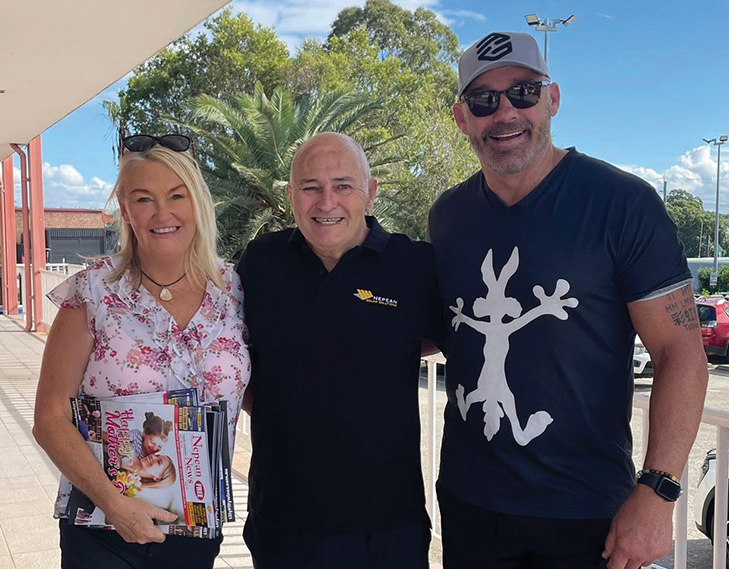
WHEN MG and I called in to see our good friend Jim Hill recently at his Nepean Solar Solutions premises in Penrith, we were relieved to see him looking remarkably well considering the serious health battle he had been through.
Jim, a familiar face to many through his business and his work as a columnist for Nepean News, suffered a stroke four months ago. He is now well into his rehabilitation and, he was keen to share his experience for one important reason – to help others recognise that a stroke does not always happen in the dramatic, sudden way many of us imagine.
Jim kindly agreed to share his story in the hope that it might encourage someone to recognise the warning signs and seek medical attention without delay.
The Stroke Foundation stresses that stroke is always a medical emergency. While the familiar F.A.S.T. test “Face, Arms, Speech, Time” remains an important way to recognise common symptoms, other signs can include weakness or numbness in a limb, dizziness, loss of balance, vision problems and difficulty swallowing. If stroke is suspected, the advice is to call 000 immediately, even if the symptoms disappear.
Here, in his own words, Jim talks about what happened, his recovery and the message he wants everyone to hear.
Kerrie: Can you take me back to the day you had the stroke? What were the very first signs that something wasn’t right?
Jim: I noticed very unusual ‘spasms’ in my left leg early in the morning. It wasn’t cramping but it was something I had not experienced before.
Throughout the morning I started losing strength and some control in my left arm. I had difficulty using my computer keyboard with my left hand and became increasingly tired throughout the morning.
Kerrie: At what point did you realise it was serious, and how quickly were you able to get medical help?
Jim: I felt extremely tired mid-morning and finally called my wife, Jill, to come and pick me up so I could go home for a sleep.
By the time she picked me up, my voice was slurring and she saw that the left-hand side of my face had dropped. She took me straight to Nepean Hospital where I was admitted. The staff and treatment were terrific.
Kerrie: What were the biggest challenges you faced immediately after the stroke, both physically and emotionally?
Jim: My left side was impacted, with walking difficult, and my left arm was best described as having an uncooked sausage hanging off my shoulder!
One of the biggest impacts was the loss of fitness and strength, which is still significantly lower and weaker than what it was prior.
Emotionally, it was very disappointing and somewhat concerning as to how well I would recover.
Kerrie: How is your rehabilitation going, and what improvements have you noticed since it happened?
Jim: Now, four months on, I have most of my functionality back, mainly through good luck and a lot of physio — from finger tapping, light weights and stretching, and finally long walks.
Typing is still difficult with my left hand and occasionally my speech is a little slurred. I found that there is such a thing as a jaw physiotherapist!
My movements have improved with physio under specialised plans that gradually target areas that allow the motion of the joints to improve.
Still a way to go.
Kerrie: Looking back, is there anything you wish you had known about stroke symptoms or risk factors before this happened?
Jim: I understood the symptoms of strokes and the acronym F.A.S.T., but I assumed that strokes were sudden and definitive — they’re not.
My stroke was the result of a blood clot that either burst or simply passed through a part of the brain, causing damage to surrounding tissue. Simply, the result was I had to retrain the controls to my left-hand side.
I don’t know what definitively caused mine and I was relatively fit prior to it.
Kerrie: What would you say to someone who notices these symptoms in themselves or a loved one but is tempted to ‘wait and see’?
Jim: Obviously get to a hospital quickly, but in saying that, my symptoms were cumulative and happened over a six-hour period, from the leg spasms to the drooping face.
Looking back, though, I could have paid more attention to the loss of control in my left hand and taken the time to get checked out then. Hindsight is a wonderful thing, though.
Do not wait and see. Take an hour out of your schedule and get yourself checked out if you feel anything like this occurring.
I was lucky. Many others aren’t.
A message worth sharing.
Jim’s experience is a timely reminder that stroke symptoms can vary and may develop over time. The Stroke Foundation says the most common signs are facial weakness, arm weakness and difficulty speaking, but there are other possible symptoms too.
Most importantly, if you or someone around you experiences signs of a stroke, don’t wait to see if they improve. Call 000 immediately. Even when symptoms disappear after a short time, they can be a warning of a transient ischaemic attack (TIA) and still require urgent medical attention.
I am delighted to see Jim making progress and beginning the long road back to full strength. He still has some way to go, but his willingness to share what happened could potentially help someone else recognise the signs sooner.
His words say it best: “Do not wait and see.”